

The AI product decision a player-coach never delegates

Hey Polly,
There’s a question buried in every AI product you own that looks like a technical detail, so it quietly gets handed to the data science team. It isn’t a technical detail; it’s a product decision wearing a lab coat. And when you delegate it, your team can do everything right, hit every number you asked for, and make your product worse — while you’re congratulating them on the win.
That’s exactly what happened to Nico Posner.
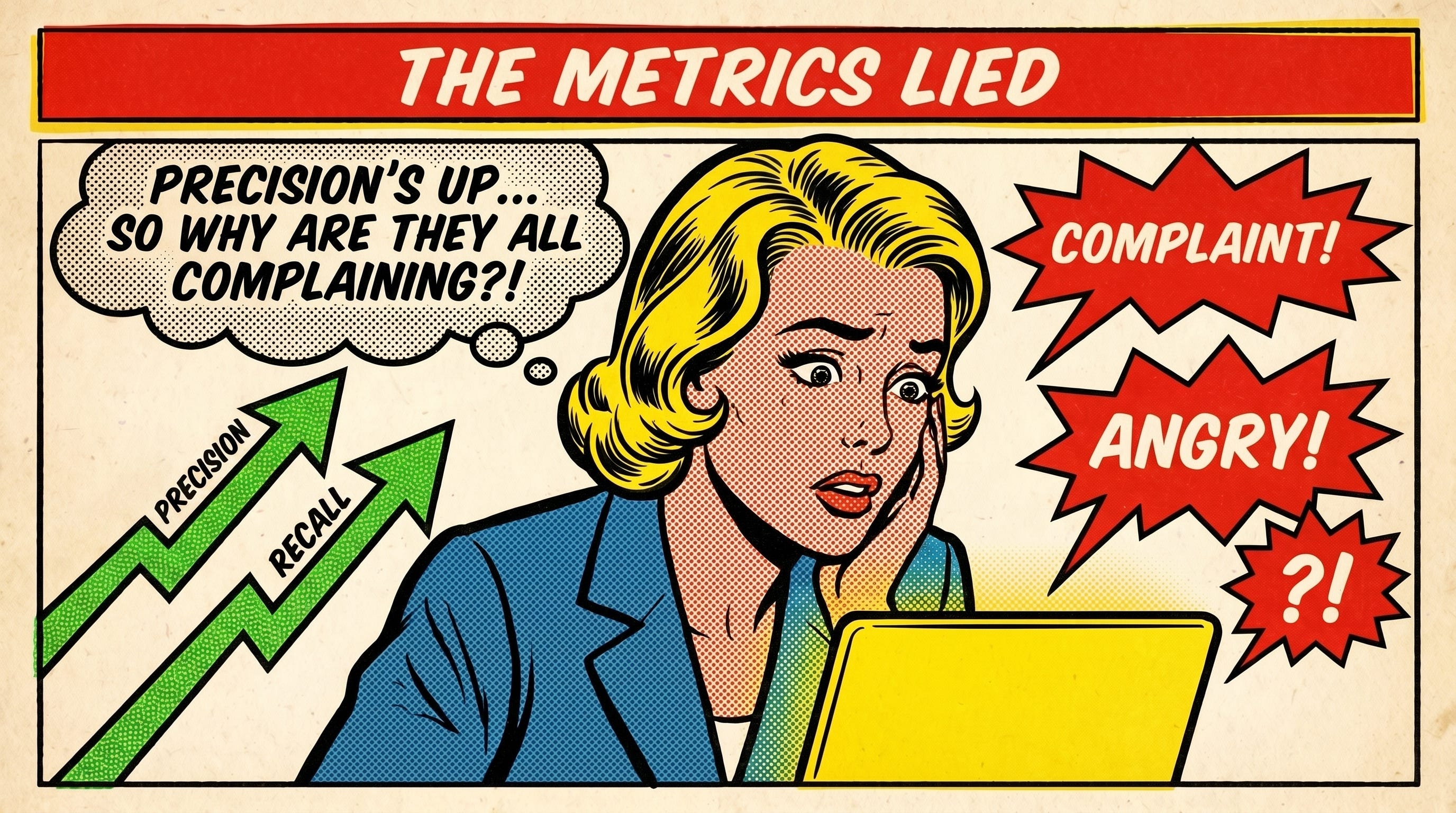
His team at Xero had built a cash flow forecasting model for over 100,000 small businesses. He asked the data science team to improve precision. They delivered: fewer false positives, cleaner results. Precision went up. BUT - customer complaints went up too.
Here’s the trap. The model got better at filtering out bad predictions, but it also started quietly dropping a specific kind of transaction: the high-dollar ones. And for the user, a missing prediction was far more painful than a wrong one: three clicks to delete a bad prediction, a dozen steps to research and re-enter a missing one. The data science team had done their job perfectly. They optimized for exactly what was asked. The failure was in the ask without the right guardrails.
Nico’s take: “You can’t just hand the metric question to the data science team. You have to own it as a product person.” Precision vs. recall — which errors your users will forgive and which ones will make them leave — is a product call. It takes knowing the user’s workflow at a level no dashboard will ever show you. You had to feel the difference between three clicks and twelve.
That story is from Nico’s first episode on the AI Product Leader podcast (Ep 23), where he walked through how his team at Xero built AI-powered analytics for small business owners. It’s one of the clearest examples I’ve heard of what separates a product leader who manages AI at a distance, from one who actually leads it.
When I talked to Nico again for Ep 60 (out now!), the context had shifted completely. He’s now VP of Product Management at Q3D Sensing, and the product is AuraGO™ — a compact, lightweight LiDAR sensor that captures physical reality in 3D. Hardware. Lasers firing 130,000 points per second. A device that snaps onto your phone and digitizes construction sites, warehouses, and infrastructure at centimeter-level precision.
You cannot vibe-code a LiDAR sensor.
Now, Nico is doing the same thing at Q3D that made him effective at Xero: staying close enough to understand the decisions that only a product leader can make. Which customer segments go first? What precision level is actually necessary vs. what the industry assumes? Where does the iPhone’s built-in LiDAR stop being useful and where does AuraGO’s range begin? Those are product calls, not engineering calls. Nico uses AI tools daily to make them — for market research, synthetic user creation, and competitive analysis — and treats tool evaluation as a team practice rather than an individual side project. He describes how fast-moving AI software helps him and his team move quickly when slower-moving, higher-cost hardware cycles hang in the balance.
Whether you’re shipping a LiDAR sensor or a SaaS dashboard, the question is the same. Are you close enough to know when the right answer is technically correct but operationally wrong?
That’s the work. And nobody can do it for you. Listen to the full episode to hear how an AI player-coach does it in action.
Ep 60: Nico Posner on AuraGO and Q3D Sensing (out now!)
Watch or listen → YouTube · Apple Podcasts · Spotify
Ep 23: The One Mistake Most AI Teams Make
Watch or listen → YouTube · Apple Podcasts · Spotify
Polly Allen
AI Career Boost
New to The AI Player-Coach? This newsletter is for Director+ product leaders becoming indispensable AI leaders.
Share this with any product leaders you know who are ready to roll up their sleeves beside their teams to lead like player coaches in the age of AI.